A single failed freezer unit during peak shopping hours can cost a supermarket between AED 15,000 and AED 80,000 in spoiled inventory, emergency repair fees, and lost sales — not counting the reputational damage with customers. Yet most of these breakdowns are entirely preventable.
This guide covers everything facilities managers and store supervisors need to know about commercial supermarket freezer maintenance: the exact steps, the right frequencies, what temperatures to target, and the UAE-specific factors that accelerate wear on refrigeration equipment.
Why Proper Freezer Upkeep Is a Business-Critical Priority
Supermarkets in the UAE and GCC operate their refrigeration systems continuously — often at temperatures 25–35°C lower than the ambient store environment. This constant thermal load means even minor neglect compounds quickly. Industry data from the Arab Society of Air Conditioning and Refrigeration Engineers shows that poorly maintained commercial freezers consume 20–40% more energy than serviced units, and that 67% of compressor failures are linked to dirty condenser coils or refrigerant issues that went undetected.
Regular commercial refrigeration servicing helps you:
- Maintain food-safe temperatures consistently (0°F / -18°C for frozen goods)
- Reduce energy bills by 20–35% compared to unserviced units
- Prevent sudden breakdowns and avoid emergency call-out costs
- Stay compliant with UAE Food Safety Law No. 10 of 2015 requirements
- Extend equipment lifespan from an average of 8 years to 12–15 years
Step-by-Step Supermarket Freezer Maintenance Procedure
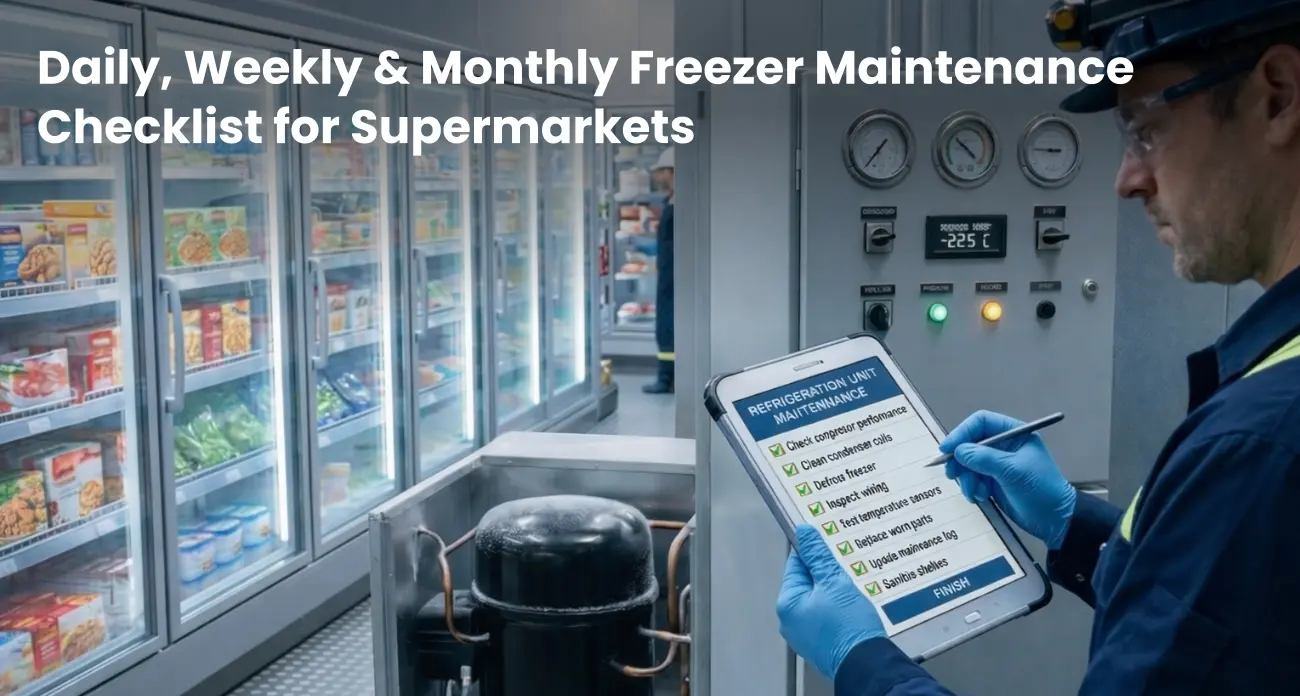
Follow this structured procedure for all commercial display freezers, glass-door units, combi freezers, and walk-in installations.
Step 1 — Monitor and verify temperature consistency
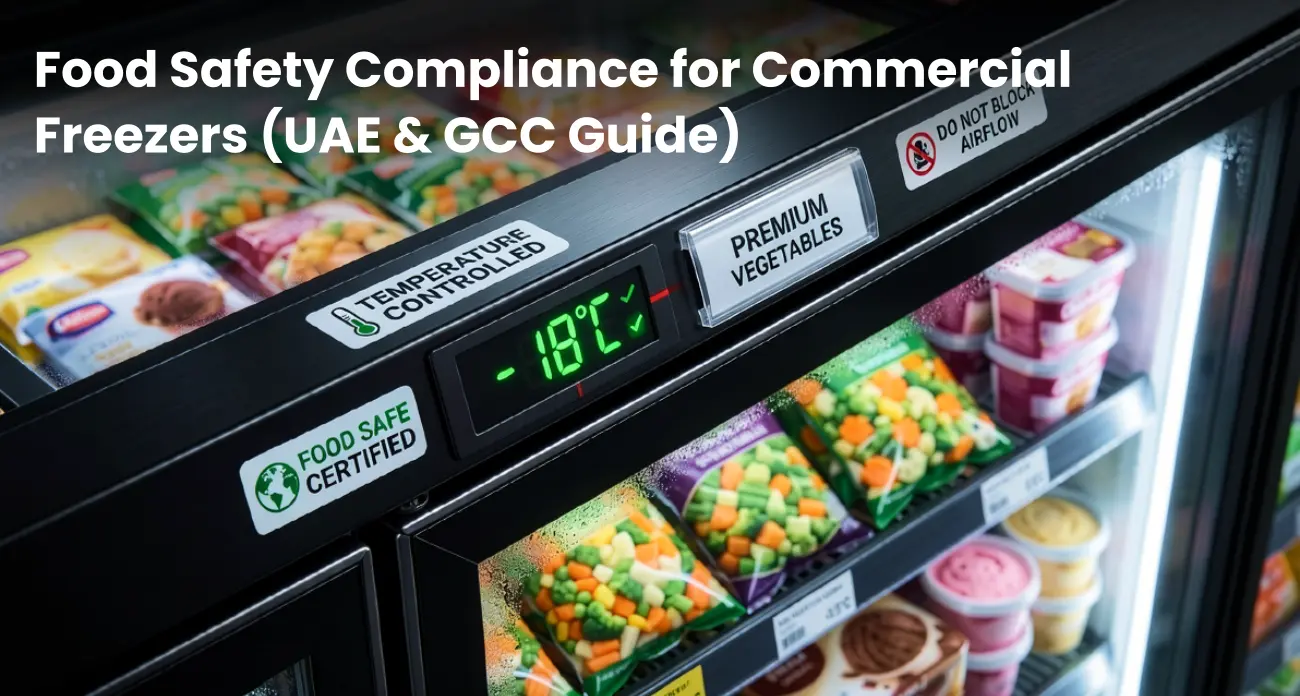
Frozen food display cases must hold -18°C (0°F) or below at all times, per UAE ESMA food safety standards. Walk-in freezers should maintain -20°C to -23°C to account for door openings. Check the following daily:
- Read digital temperature displays at the start and end of each shift
- Calibrate probes monthly — probes drift by ±1–2°C over time
- Set alarm thresholds at -15°C so staff are alerted before product safety is at risk
- Log temperatures in a signed record sheet for compliance audits
UAE tip: Summer ambient temperatures of 45–48°C put extraordinary strain on condensing units. Increase temperature checks to every 4 hours during June–September.
Step 2 — Clean condenser coils (weekly)
Condenser coils reject heat to the environment. In a busy supermarket, they accumulate dust, grease particles, and fibres within days — especially in bakery-adjacent aisles. Dirty coils force the compressor to work 15–20% harder, directly raising energy costs and compressor wear.
- Switch off the unit and allow it to reach ambient temperature
- Use a soft-bristle coil brush to loosen debris — never a pressure washer on fins
- Blow compressed air from the clean side through the coil to expel debris
- Use a coil-safe alkaline cleaner (pH 8–10) for grease build-up in kitchen-adjacent units
- Ensure minimum 30cm of clear space around the condensing unit for airflow
Step 3 — Inspect and clean evaporator coils
The evaporator coil sits inside the freezer cabinet and is prone to frost bridging — ice sheets that block airflow and drastically reduce cooling capacity. Inspect weekly, clean monthly.
- Check for uneven frost patterns (indicates blocked airflow or failing defrost heater)
- Manually defrost if ice exceeds 6mm thickness before the scheduled defrost cycle
- Clean coil surfaces with a pH-neutral coil cleaner — never acids on aluminium fins
- Inspect the defrost heater elements for continuity during the annual deep service
Step 4 — Clean and inspect drain pans and drain lines
Blocked drain pans are one of the most common yet overlooked causes of water damage and bacterial growth in commercial freezers. Stagnant water in drain pans creates ideal conditions for mould and Listeria — a direct food-safety risk.
- Remove and clean drain pans with a 200 ppm chlorine solution weekly
- Flush drain lines with warm water to clear biofilm and debris
- Pour a small amount of food-grade sanitiser into drain lines monthly
- Check that drain line outlet is clear and not blocked behind the unit
Step 5 — Inspect door gaskets and hinges
A worn door gasket is one of the most expensive energy leaks in a display freezer. A gap as small as 3mm around a glass door can increase energy consumption by up to 30% and cause the compressor to run continuously, leading to premature failure.
- Run the "paper test": close the door on a sheet of paper — it should grip firmly at all points
- Inspect visually for cracks, hardening, or deformation — gaskets degrade from cleaning chemicals
- Clean gaskets with mild soapy water only — avoid solvent-based cleaners that cause brittleness
- Replace gaskets that fail the paper test — do not attempt repair with tape
- Check hinge tension: doors should close fully with gentle force and not bounce back open
Cost tip: Gasket replacement costs AED 150–400 per door. A running compressor caused by gasket failure adds AED 800–1,500/month to your electricity bill. Replace proactively.
Step 6 — Manage defrost cycles correctly
Most commercial supermarket freezers run 3–4 automatic defrost cycles per day, typically at night and during low-traffic hours. Incorrect defrost settings cause either excessive ice build-up (under-defrost) or product temperature excursions (over-defrost).
- Set defrost cycles to coincide with lowest footfall periods (2 AM, 5 AM, 10 AM, 2 PM)
- Each cycle should last no longer than 25–30 minutes for display cases
- Verify that the termination thermostat (typically set at +10°C to +15°C) is functioning
- If products show repeated partial thawing, a technician should audit the defrost controller
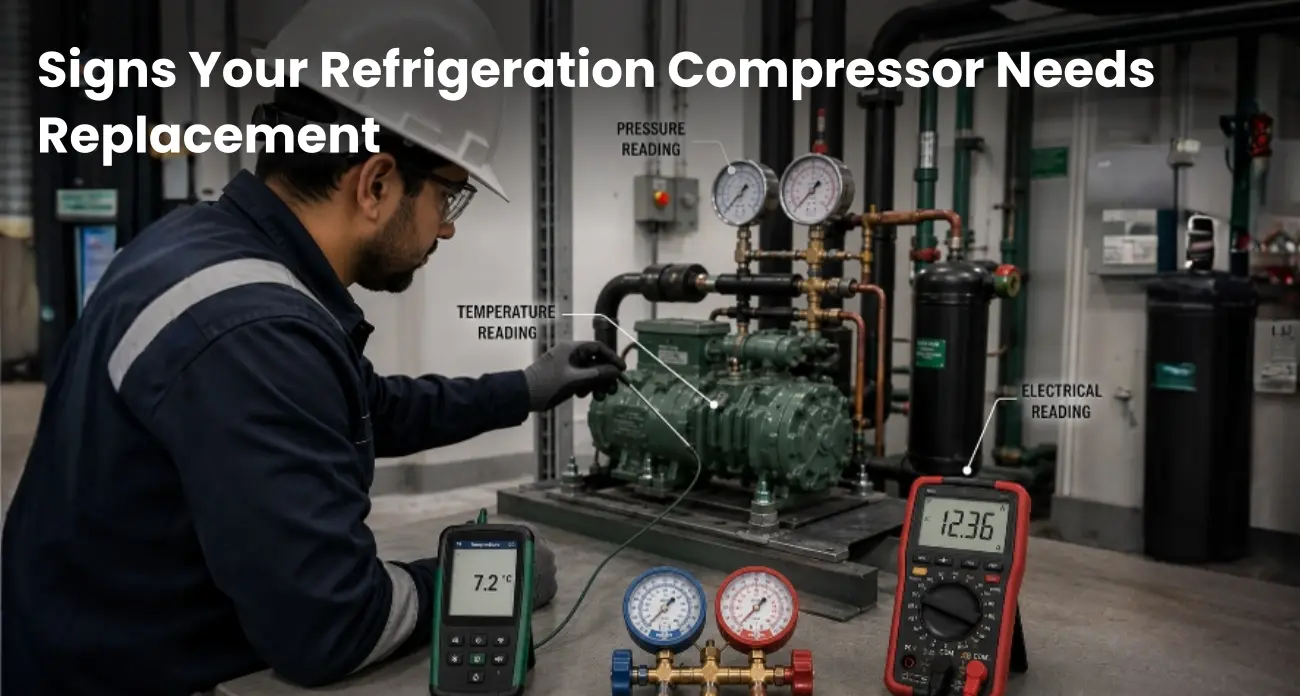
Step 7 — Monitor compressor health and refrigerant levels
The compressor is the most expensive component in any refrigeration system. Early warning signs — if caught — cost AED 200–800 to fix. Ignored, they lead to compressor replacement at AED 5,000–25,000.
- Listen for unusual sounds: rattling (loose mounts), grinding (bearing failure), clicking (thermal overload tripping)
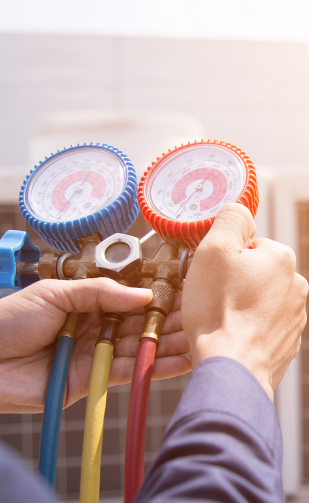
- Check suction and discharge pressures quarterly against manufacturer specs
- Have a certified technician check refrigerant charge annually — low refrigerant damages compressor valves
- Monitor running current against nameplate FLA — sustained over-current = failing compressor
- Log runtime hours; most compressors are warranted to 40,000–60,000 hours
UAE regulatory note: Under UAE Environmental Regulations, only certified technicians may handle refrigerants. Refrigerant top-ups must be logged and reported. Using uncertified contractors voids your equipment warranty and may result in fines.
Maintenance Frequency Reference Table
| Task | Daily | Weekly | Monthly | Every 3–6 months | Annual |
|---|---|---|---|---|---|
| Temperature log (all units) | ✓ | ||||
| Door gasket visual check | ✓ | ||||
| Product arrangement & airflow | ✓ | ||||
| Condenser coil brushing | ✓ | ||||
| Drain pan cleaning | ✓ | ||||
| Evaporator coil inspection | ✓ | ||||
| Gasket paper test | ✓ | ||||
| Drain line flush | ✓ | ||||
| Defrost cycle verification | ✓ | ||||
| Full professional service | ✓ | ||||
| Refrigerant level check | ✓ | ||||
| Compressor pressure test | ✓ | ||||
| Complete deep service + parts inspection | ✓ |
UAE & GCC-Specific Maintenance Considerations
Standard commercial refrigeration guidelines are written for temperate climates. In the UAE, where ambient temperatures reach 48°C in summer and relative humidity can exceed 85% in coastal cities, your supermarket freezer servicing schedule needs to be more aggressive.
- Condenser overload (May–September): Clean condenser coils twice weekly during summer months, not just weekly. External ambient temperature directly raises condensing pressure, reducing efficiency by 8–15% per 5°C rise above design conditions.
- High humidity and gasket degradation: Coastal locations (Dubai Marina, Abu Dhabi Corniche, RAK) experience significant moisture infiltration through door seals. Inspect gaskets every two weeks and expect 30–40% shorter gasket lifespans compared to European installations.
- Sand and dust ingress: Units near store entrances or loading bays accumulate dust on condenser fins within 48–72 hours. Install filter screens on condensing unit air intakes and replace them monthly.
- Water quality for evaporative components: UAE water is high in dissolved salts. Use distilled water or a commercial descaling agent in evaporative components to prevent scale build-up on heat exchange surfaces.
Troubleshooting Common Supermarket Freezer Problems
| Symptom | Likely Cause | DIY Fix | Call a Technician If |
|---|---|---|---|
| Temperature rising above -15°C | Dirty condenser coils / low refrigerant / failed defrost | Clean coils, check door seals | Problem persists after coil cleaning |
| Heavy ice build-up on evaporator | Defrost heater fault / blocked drain / door left open | Manual defrost, check drain | Recurs within 24 hours |
| Unit running continuously (never cycling off) | Gasket failure / low refrigerant / high ambient temp | Replace gasket, check surroundings | New gasket doesn't resolve it |
| Rattling / vibration noise | Loose fan blade / compressor mounts worn / debris in fan | Check fan area for debris | Noise is from compressor area |
| Water pooling on floor | Blocked drain line / cracked drain pan | Flush drain line | Drain pan is cracked (replacement needed) |
| High energy bills (sudden increase) | Dirty coils / gasket failure / refrigerant low | Full inspection of coils + seals | All visible checks pass — refrigerant test needed |
When to Call a Professional vs. DIY
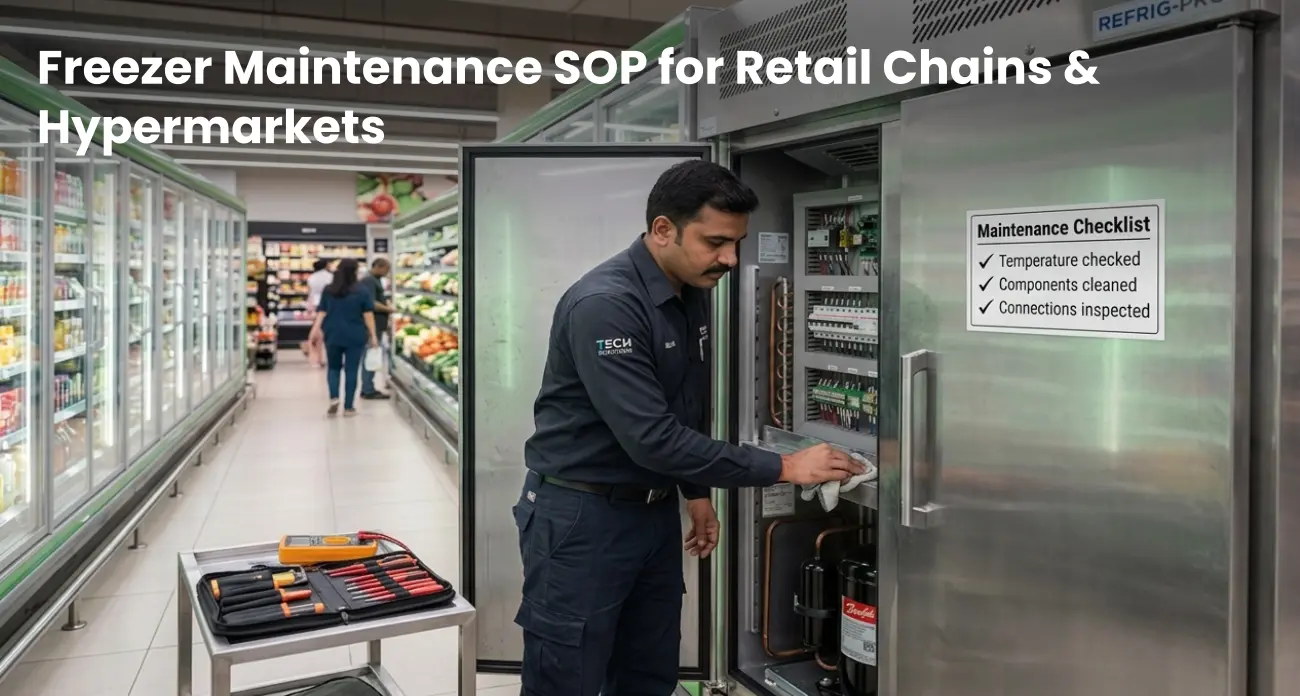
Facilities staff can handle daily and weekly checks without specialist training. However, the following tasks require a certified refrigeration engineer:
- Any work involving refrigerant (top-up, recovery, leak detection) — legally required under UAE Environmental Regulations
- Compressor electrical diagnosis or replacement
- Defrost controller programming and calibration
- Refrigerant pressure testing and system balancing
- Leak detection on evaporator or condenser circuits
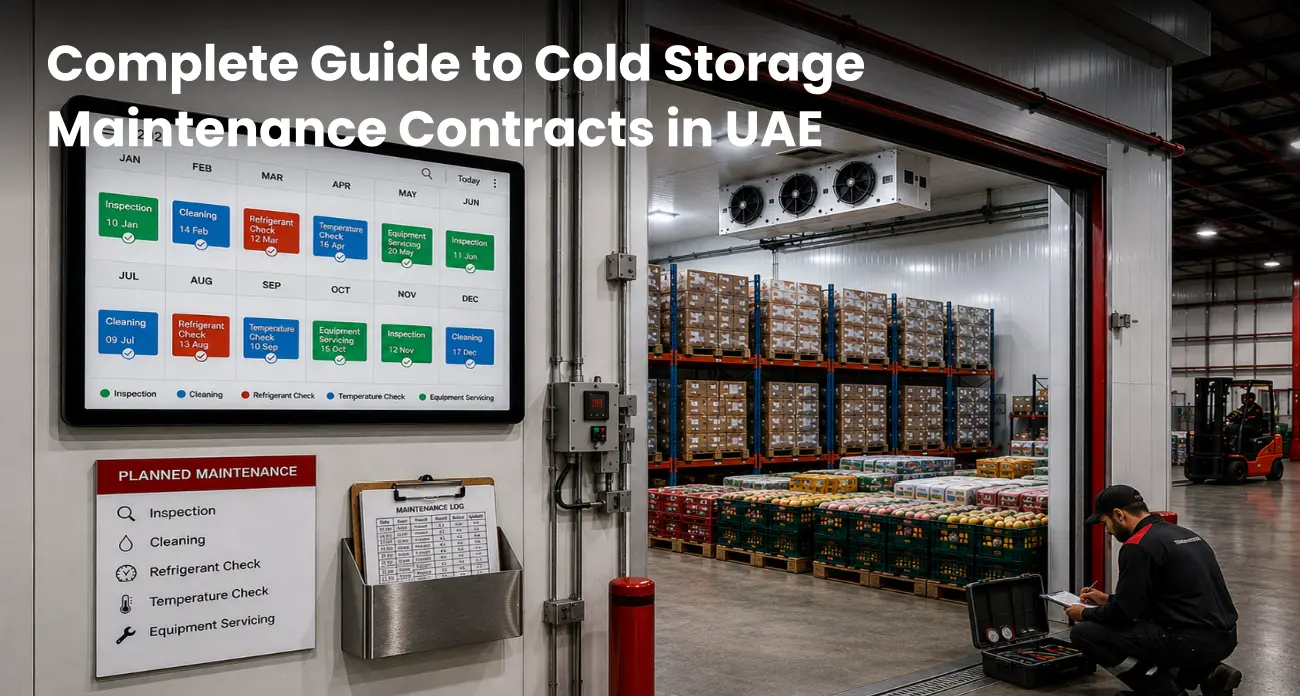
For supermarkets operating 5+ units, an Annual Maintenance Contract (AMC) typically costs 8–12% of equipment value per year — significantly less than one emergency repair. Explore Thermodynamics ME's Refrigeration AMC →
Frequently Asked Questions
What temperature should a commercial supermarket freezer be set to?
Frozen food display cases must maintain -18°C (0°F) or below, per UAE ESMA and international food safety standards. Walk-in freezers are typically set to -20°C to -23°C to account for temperature rise from door openings and product loading. Temperatures above -15°C for more than 2 hours constitute a food safety incident requiring product inspection.
How often should commercial supermarket freezers be professionally serviced?
In the UAE and GCC, professional servicing every 3 months is recommended due to extreme ambient temperatures and dust levels. In more temperate climates, every 6 months is standard. Annual deep-service contracts that include refrigerant checks, compressor testing, and full system diagnostics are the most cost-effective approach for multi-unit supermarkets.
How do I know if my freezer gasket needs replacing?
Use the paper test: close the door on a sheet of paper at several points around the frame. If the paper slides out easily without resistance, the gasket is no longer sealing properly and should be replaced. Visible cracks, hardening, or deformation are also clear signs. Most commercial gaskets need replacement every 2–3 years under normal use.
Why is there ice build-up inside my commercial freezer?
Excessive ice build-up on the evaporator coil usually indicates one of three problems: (1) the defrost heater has failed and the automatic defrost cycle isn't completing, (2) a door seal is leaking warm, humid air into the cabinet, or (3) the drain line is blocked, causing meltwater to refreeze. Check door seals first, then inspect the defrost system.
How can I reduce energy costs from supermarket freezers?
The biggest energy savings come from: clean condenser coils (saves 15–20%), properly sealed door gaskets (saves 10–30% per unit), correct product loading that doesn't block airflow vents, setting defrost cycles to run during off-peak hours, and upgrading to LED lighting inside cabinets (reduces heat load by 30–40% vs. fluorescent). Smart monitoring systems that alert staff to door-open events can save an additional 5–10%.
How often should condenser coils be cleaned in a supermarket?
In a supermarket environment, condenser coils should be cleaned weekly. In the UAE, during summer months (May–September), twice-weekly cleaning is recommended due to elevated dust levels and higher ambient temperatures. Coils in bakery-adjacent or high-traffic areas accumulate grease deposits faster and may need more frequent attention.
What is the lifespan of a commercial supermarket freezer?
With proper servicing, commercial display freezers typically last 12–15 years. Neglected units often require major repairs or replacement within 6–8 years. Key lifespan factors are compressor care, refrigerant charge maintenance, and coil cleanliness. Units with documented servicing history also retain higher resale value.
What cleaning products are safe to use on supermarket freezer coils?
Use pH-neutral or mildly alkaline (pH 8–10) coil cleaners for general cleaning. For heavy grease, alkaline coil cleaners are effective but must be fully rinsed. Never use acid-based cleaners on aluminium fins — they cause irreversible corrosion. For drain pans and internal surfaces in food zones, use food-grade sanitisers at concentrations specified by the manufacturer.
Can I top up refrigerant in my supermarket freezer myself?
No. In the UAE, handling refrigerants requires a certified engineer and proper F-gas handling equipment. Refrigerant top-ups must be documented under UAE environmental regulations. Unlicensed refrigerant work also voids equipment warranties from manufacturers. Contact a certified refrigeration contractor for any refrigerant-related work.
What is an AMC (Annual Maintenance Contract) for commercial refrigeration?
An AMC is a scheduled service agreement with a certified refrigeration contractor who performs regular inspections, cleaning, and preventive repairs at a fixed annual fee. For supermarkets in the UAE with 10+ units, an AMC typically costs 8–12% of equipment value per year but prevents emergency call-out costs (AED 500–2,000 per visit) and significantly reduces the risk of product loss incidents.
How should supermarket staff be trained on freezer care?
Staff training should cover: never blocking air vents with products, closing doors fully after each use, reporting unusual sounds or temperature alarms immediately, not overloading units beyond the load line, and following the FIFO (first in, first out) rotation system that minimises door-open time. A laminated quick-reference checklist near each unit significantly improves staff compliance.
Conclusion
Effective commercial supermarket freezer maintenance is not a cost — it is a protection strategy for your inventory, your energy budget, and your food safety compliance record. A structured weekly routine, quarterly professional servicing, and attention to the UAE-specific factors of heat, humidity, and dust will keep your equipment running efficiently for 12–15 years.
If you manage multiple freezer units across one or more supermarket locations in the UAE, GCC, or wider Middle East region, Thermodynamics ME offers dedicated Refrigeration AMC contracts and emergency call-out services backed by ISO 9001-certified engineers. Request a quote today →