A commercial refrigeration compressor is one of the most important components in a cold room, freezer, chiller or temperature-controlled storage system. When it begins to lose performance, the consequences can extend beyond the equipment itself. Poor temperature control, increased energy consumption, repeated breakdowns and operational disruption can affect businesses that depend on reliable refrigeration.
However, impaired cooling performance should not automatically be attributed to compressor failure. Similar symptoms can result from refrigerant issues, electrical faults, condenser problems, fan failures or control-system malfunctions. For this reason, identifying the warning signs is only the first step. A proper technical assessment is necessary before deciding whether a commercial refrigeration compressor requires repair or replacement.
Here are seven signs that may indicate your refrigeration compressor needs professional attention and possible replacement.
What Does a Commercial Refrigeration Compressor Do?
The compressor serves as the driving component of the refrigeration cycle. It compresses refrigerant vapour and circulates it through the system, enabling heat to be transferred away from the refrigerated space.
In commercial applications, compressors operate continuously or for extended periods to maintain the required storage temperature. Their performance directly affects cooling capacity, energy consumption and overall refrigeration reliability.
Consequently, a compressor malfunction can compromise the performance and reliability of the entire refrigeration system. At the same time, faults elsewhere in the refrigeration circuit can place additional strain on the compressor. This is why professional diagnosis should consider the complete system rather than treating the compressor as an isolated component.
1. The Refrigeration System Struggles to Maintain Temperature
One of the clearest warning signs is a gradual decline in cooling performance. The cold room, freezer or refrigerated cabinet may take longer to reach the required temperature or struggle to maintain a stable set point.
Common operational symptoms include:
- Temperature fluctuations
- Slow cooling or pull-down times
- Extended temperature recovery after door openings
- Continuous or unusually long compressor operation
- Difficulty maintaining the required storage temperature
A failing refrigeration compressor can contribute to these problems, particularly if it is no longer delivering the required capacity.
However, poor cooling performance does not automatically confirm compressor failure. Refrigerant leaks, dirty condenser coils, evaporator problems, airflow restrictions and faulty controls can produce similar symptoms. A qualified technician should therefore investigate the underlying cause before recommending compressor replacement.
2. The Compressor Produces Unusual or Excessive Noise
Commercial refrigeration systems generate operational noise, but a noticeable change in sound should not be ignored.
Warning signs may include:
- Knocking or banging
- Grinding sounds
- Persistent rattling
- Excessive vibration
- Repeated clicking during start-up
Some of these sounds may indicate mechanical wear or internal compressor problems. Others may originate from mounting components, electrical controls, fans or other parts of the refrigeration system.
The important consideration is whether the noise is new, increasing or accompanied by reduced cooling performance. When unusual sounds occur repeatedly, a technical inspection can help determine whether the compressor itself is affected or whether another component is responsible.
3. The Compressor Frequently Overheats
A compressor operating at excessive temperatures may be experiencing abnormal mechanical, electrical or refrigeration-system conditions.
Possible contributing factors include:
- Poor condenser performance
- Restricted airflow
- High operating pressure
- Electrical problems
- Incorrect refrigerant conditions
- Excessive system load
- Internal compressor deterioration
Overheating should not be treated as a normal operating condition. Repeated exposure to excessive temperatures can affect component reliability and increase the risk of further system failure.
Before replacing the compressor, technicians should identify why it is overheating. In some cases, correcting the underlying system problem may prevent further damage. If testing confirms significant internal deterioration, compressor replacement may become the more appropriate solution.
4. The Compressor Starts and Stops Repeatedly
Short cycling occurs when the compressor starts and stops more frequently than expected. This repeated cycling can increase mechanical and electrical stress on the refrigeration system.
Possible signs include:
- Frequent compressor start-up and shutdown
- Repeated overload trips
- Failure to complete normal operating cycles
- Intermittent cooling performance
- Electrical protection devices activating repeatedly
Several issues can cause short cycling. These may include control faults, pressure problems, electrical supply issues, defective start components or compressor deterioration.
A compressor that repeatedly trips or fails to remain operational should therefore be professionally assessed. Replacing the compressor without identifying the root cause may result in the same problem affecting the replacement unit.
5. Energy Consumption Has Increased Without a Clear Reason
An increase in electricity consumption can indicate declining refrigeration efficiency.
When a refrigeration system takes longer to achieve or maintain the required temperature, the compressor may operate for extended periods. This may result in higher electricity consumption and increased operating expenditure.
However, energy consumption should always be assessed in the context of the complete system. A rise in energy consumption may also be caused by several other factors, including:
- Dirty heat-transfer surfaces
- Damaged insulation
- Poor door sealing
- Increased product loading
- High ambient temperatures
- Condenser airflow problems
- Refrigerant-system faults
For facility and operations managers, unexplained changes in energy consumption can provide an early indication that refrigeration performance should be investigated. Regular monitoring can help identify changes before they develop into major equipment failures.
6. The System Requires Frequent Compressor-Related Repairs
Occasional maintenance is part of operating commercial refrigeration equipment. However, repeated repairs involving the same compressor or related components may indicate a more significant problem.
Warning signs include:
- Frequent technician call-outs
- Recurring electrical faults
- Repeated overheating
- Ongoing cooling problems
- Increasing repair costs
- Repeated operational downtime
At this stage, businesses should consider the wider cost of continued repairs. The decision should not be based solely on the cost of the next repair. It should also consider equipment reliability, downtime, energy performance, spare-parts availability and the potential impact on operations.
A repair may remain practical when the fault is minor and the compressor is otherwise in good condition. However, repeated failures may justify a professional repair-versus-replacement assessment.
7. The Compressor Has Reached the End of Its Practical Service Life
There is no universal lifespan for a commercial refrigeration compressor. A compressor’s expected operational life is shaped by a range of technical and operating conditions, including:
- Operating hours
- Cooling load
- Equipment design
- Installation quality
- Preventive maintenance
- Ambient operating conditions
- Refrigerant management
- Electrical conditions
A well-maintained compressor may continue operating reliably for many years, while a poorly maintained system operating under excessive load may experience problems much earlier.
For this reason, the age of the equipment alone should not be the deciding factor when considering replacement. Instead, the decision should consider the compressor's condition, repair history, efficiency, system compatibility and future operational requirements.
Not Every Refrigeration Problem Means the Compressor Has Failed
This is an important consideration when diagnosing commercial refrigeration problems.
A refrigeration system may experience poor cooling, unusual cycling or temperature fluctuations without the compressor being the primary cause.
Other possible issues include:
- Refrigerant leaks
- Dirty or blocked condenser coils
- Condenser fan failure
- Evaporator problems
- Electrical faults
- Defective capacitors or start components
- Overload protection issues
- Sensor malfunctions
- Expansion valve problems
- Control-system faults
For this reason, replacing a compressor based solely on one visible symptom can be an expensive mistake.
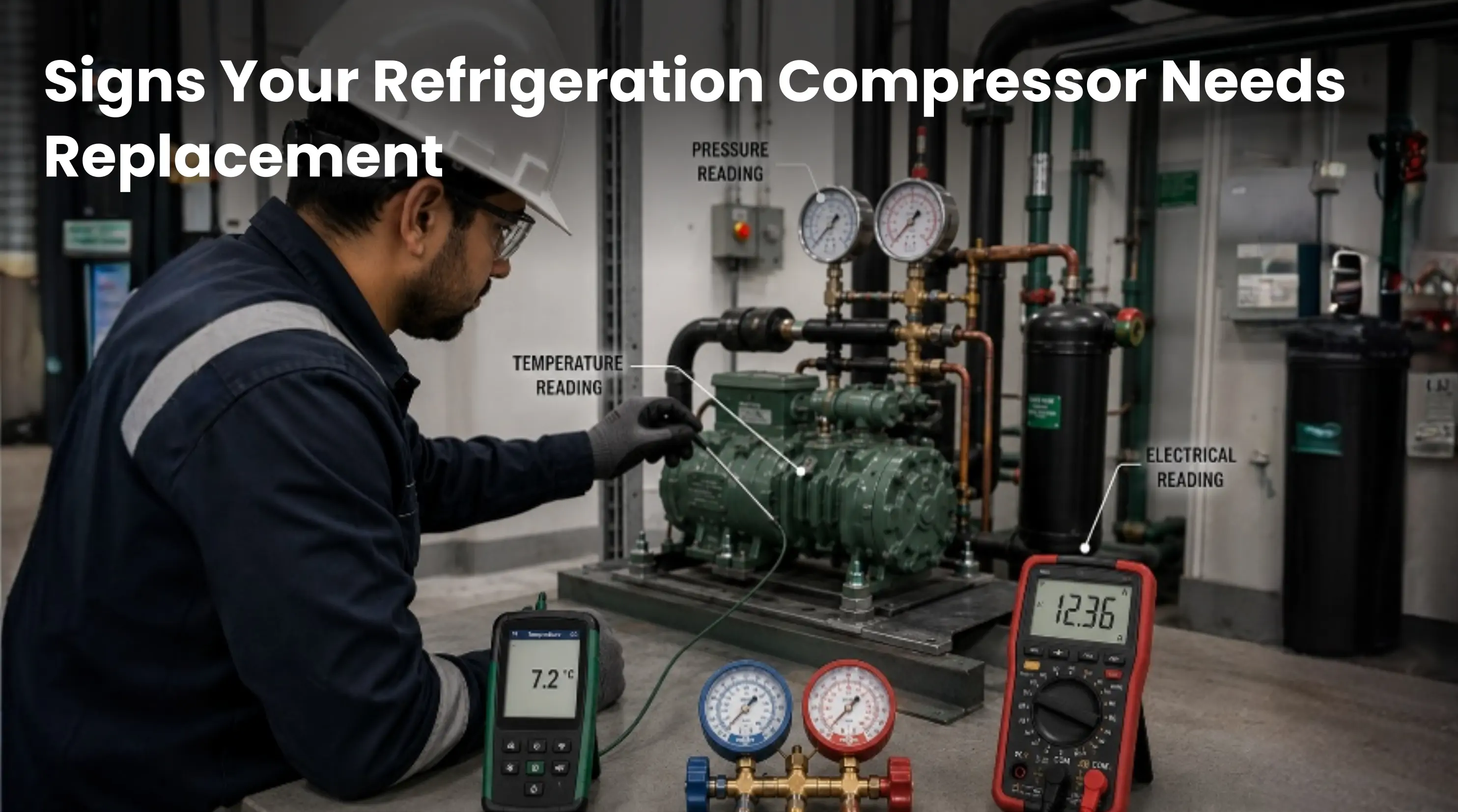
A proper technical assessment should examine the refrigeration system, operating pressures, electrical conditions, cooling performance and supporting components before confirming whether compressor replacement is required.
When Should You Repair or Replace a Refrigeration Compressor?
The choice between repairing or replacing a compressor should be based on the underlying fault and the overall condition of the refrigeration system.
| Consideration | Repair May Be Suitable | Replacement May Be Considered |
| Type of fault | Minor or external component issue | Confirmed internal compressor failure |
| Repair history | Limited previous repairs | Repeated breakdowns |
| Cooling performance | Expected to recover after repair | Continually deteriorating |
| Repair cost | Economically reasonable | Increasing or recurring costs |
| Equipment condition | System remains serviceable | Significant deterioration |
| Component availability | Parts readily available | Parts difficult to source or obsolete |
The most appropriate decision should consider both immediate and long-term operational costs.
For a business operating a cold room, supermarket freezer, food storage facility or temperature-controlled warehouse, equipment downtime can have consequences beyond repair expenses. Product protection, operational continuity and energy performance may all influence the final decision.
Why Compressor Reliability Matters in the UAE
Commercial refrigeration systems in the UAE often operate under demanding conditions. High ambient temperatures can increase cooling loads and place greater pressure on the refrigeration system, particularly its heat-rejection components.
Dust and airborne particles can also affect condenser performance if equipment is not inspected and maintained regularly.
For businesses operating in Dubai, Abu Dhabi and other parts of the UAE, refrigeration reliability is particularly important for sectors such as:
- Food and beverage
- Supermarkets and retail
- Hospitality
- Cold-chain logistics
- Pharmaceutical storage
- Healthcare
- Food processing
- Industrial temperature-controlled facilities
Regular inspection, preventive maintenance and performance monitoring can help identify developing problems before they result in unexpected operational disruption.
Professional Refrigeration Compressor Assessment and Replacement
Before replacing a commercial refrigeration compressor, the entire system should be assessed to identify the underlying cause of the issue.
A technical assessment may consider:
- Compressor condition
- Refrigeration capacity requirements
- Refrigerant compatibility
- Electrical requirements
- Operating pressures
- Condenser and evaporator condition
- Supporting component performance
- Cause of the original failure
Identifying the underlying cause is essential. Installing a replacement compressor without addressing the original system problem can expose the new equipment to similar operating conditions and potential failure.
If professional diagnosis confirms that replacement is necessary, Thermodynamics ME provides specialised commercial refrigeration compressor replacement services for commercial and industrial refrigeration systems. Its approach considers the wider refrigeration system and operational requirements when assessing equipment replacement requirements.
For businesses operating temperature-critical facilities, a professional assessment can help determine whether repair, replacement or wider system improvement represents the most practical option.
Frequently Asked Questions (FAQs)
How do I know if my commercial refrigeration compressor is failing?
Warning signs may include declining cooling performance, unusual noise, repeated overheating, frequent short cycling, extended operating hours and recurring breakdowns. However, these symptoms do not always confirm compressor failure and should be professionally diagnosed.
Can a commercial refrigeration compressor be repaired?
Some compressor-related problems can be resolved by repairing electrical controls, start components or other supporting parts. Where internal compressor failure has been conclusively identified, replacement may represent the more practical solution.
Does poor cooling always mean the compressor needs replacement?
No. Poor cooling can also result from refrigerant leaks, dirty condensers, fan failures, airflow restrictions, control faults and other refrigeration-system problems.
When Should a Refrigeration Compressor Be Repaired or Replaced?
Replacement may be considered when internal failure is confirmed, repairs are becoming frequent or costly, performance continues to decline or the wider system assessment indicates that replacement is the more practical long-term option.
Why is preventive maintenance important for refrigeration compressors in the UAE?
UAE operating conditions can place significant demands on commercial refrigeration equipment. Preventive maintenance helps identify issues affecting airflow, condenser performance, electrical components and overall system reliability before they develop into major failures.
Need a Commercial Refrigeration Compressor Assessment?
If your refrigeration system is experiencing temperature instability, repeated breakdowns, unusual compressor noise or declining performance, early technical assessment can help identify the underlying cause.
Thermodynamics ME provides refrigeration maintenance, compressor replacement, retrofit and technical support services for commercial and industrial applications across the UAE and wider GCC region. A professional assessment can help determine whether the issue can be repaired or whether compressor replacement is the most suitable long-term solution.